
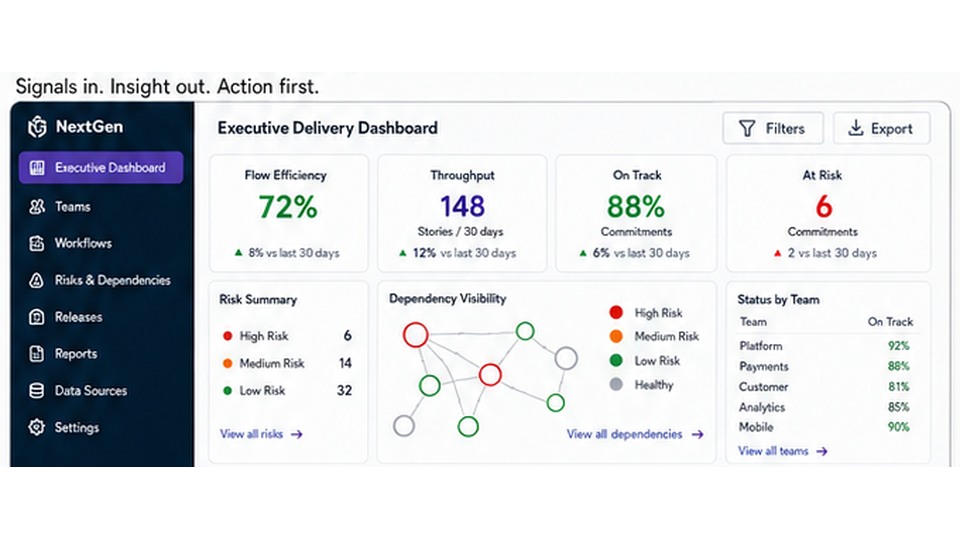
Executive View01 · Signal
See which commitment changed risk.
Start with the executive question, not another data hunt. Surface the commitment that needs attention and the evidence areas driving the change.
NextGen reads approved evidence across Jira, Confluence, architecture, risk and operational sources to show which commitment is exposed, why it is exposed, what the miss could cost and what decision should happen next.

Decision Intelligence can sound abstract. This is the product story in three screens: identify the commitment, trace the hidden dependency and focus the next action. Then explore the same flow in the live walkthrough below.
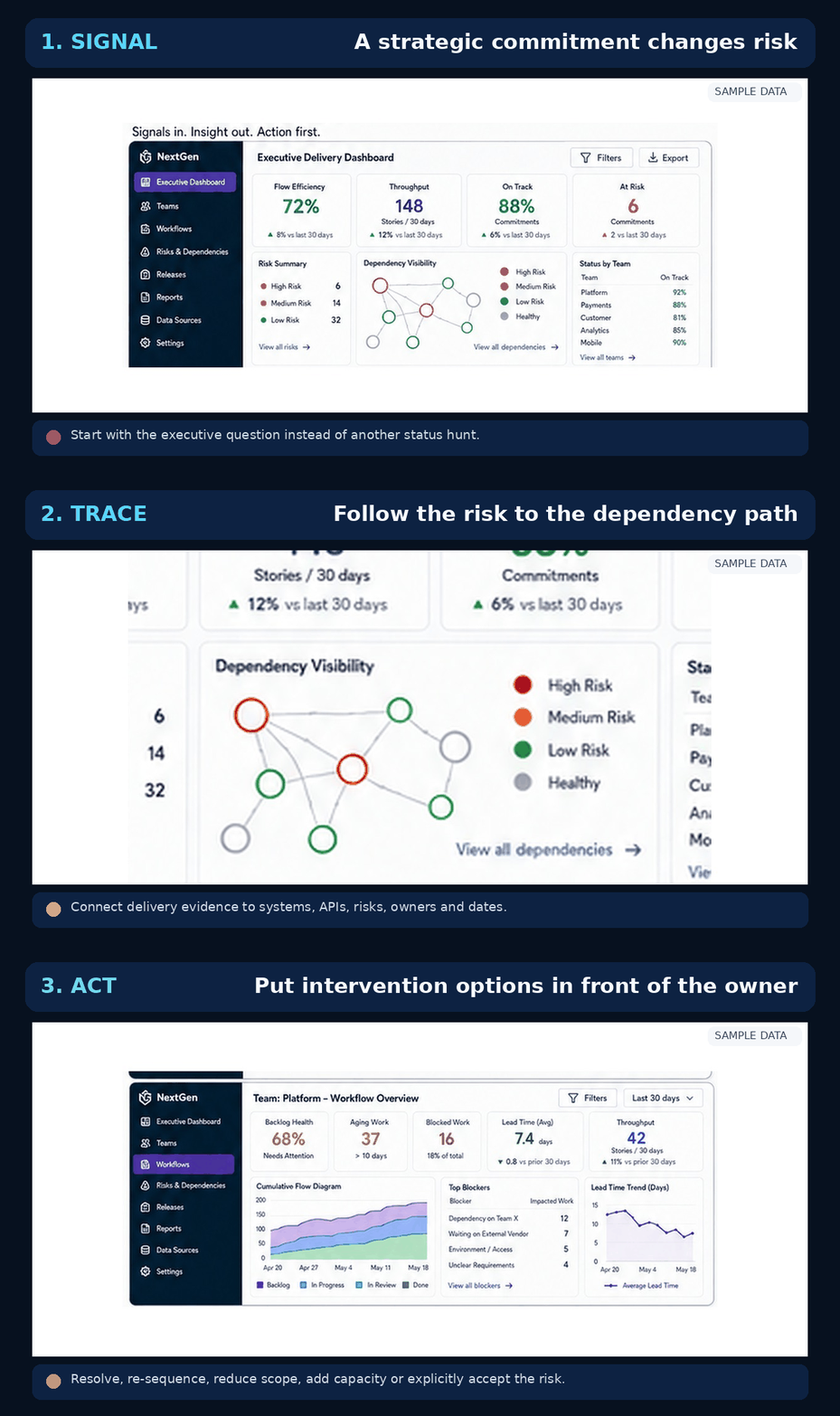
The animation shows the same product pattern the interactive walkthrough uses: surface a commitment signal, trace the dependency path and focus the intervention. It uses approved product concept views and sample data.
Start with the executive question, not another data hunt. Surface the commitment that needs attention and the evidence areas driving the change.
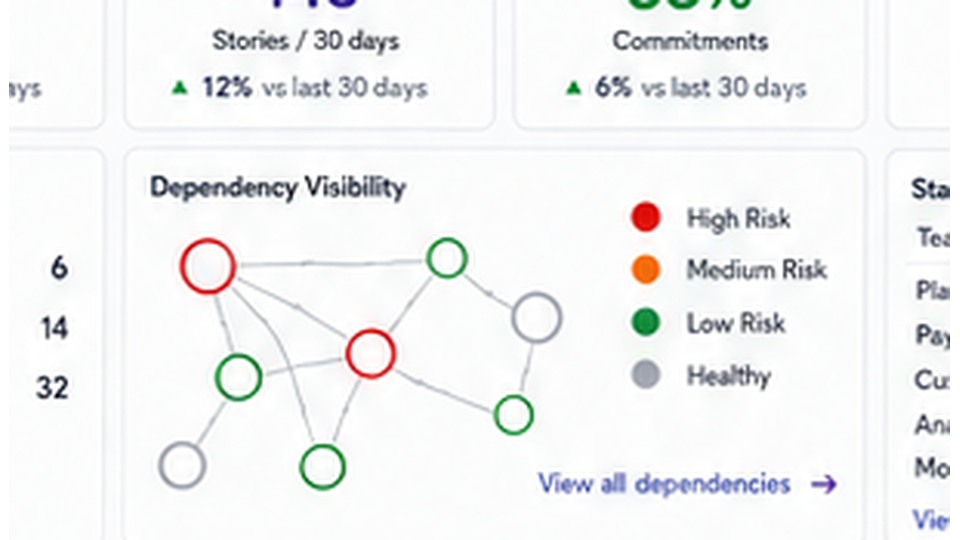
Move from status to cause by connecting the delivery signal to the teams, technical dependencies, owners and source evidence that can change the outcome.
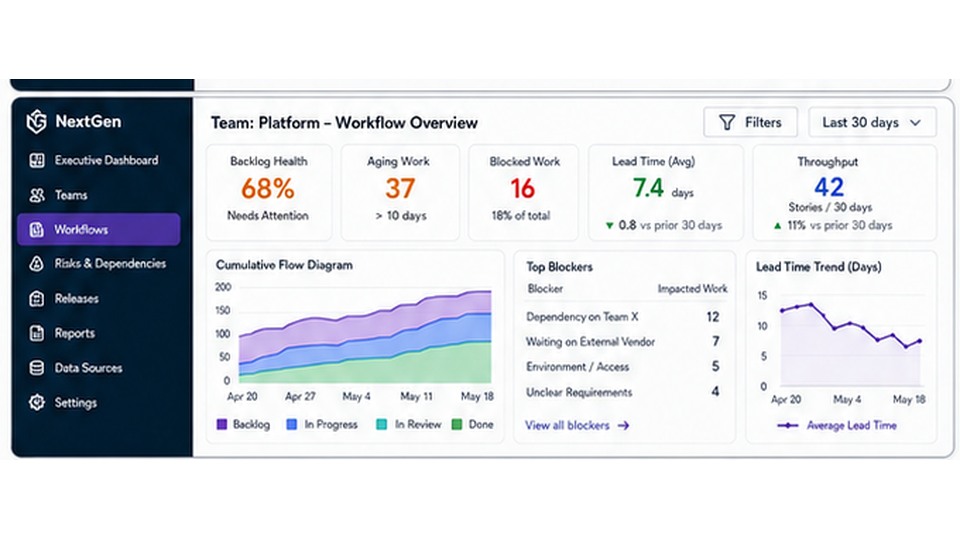
Use flow, blocker and dependency context to decide whether to resolve a dependency, re-sequence work, reduce scope, add capacity or explicitly accept the risk.
The enterprise often already has the data, dashboards and systems of record. The problem is that delivery, architecture, API, risk, capacity and business evidence are interpreted in different places. NextGen tests whether connecting that context can get an accountable decision in front of leadership earlier.
This is a sample scenario, not a customer case study. It shows the kind of cross-source reconciliation NextGen is designed to reduce.
Refresh the evidence, flag the exposure, explain the cause and put the intervention in front of the owner.
Use approved read-only APIs, exports or files from delivery, architecture, risk and operational sources.
Compare current flow, readiness, dependency and risk evidence with the committed outcome and date.
Show the dependency, team, system, risk or capacity condition driving the exposure and the evidence behind it.
Sequence work, reduce scope, resolve a dependency, add capacity or accept the risk with an evidence trail.
The homepage is intentionally focused on one buyer problem: protecting strategic delivery commitments. Delivery Intelligence is the commercial application. Enigma X is the evidence relationship engine underneath it. The technical details now live on dedicated product pages so executives can understand the value before diving into architecture.
Which commitment is exposed, why, what is affected, what could the miss cost and what decision belongs to the accountable owner?
Connect approved evidence, relationships, dependencies and confidence while preserving the source trail.
Only expand into adjacent solutions after the first commitment use case demonstrates measurable decision value.
See the full product story, executive use case, decision flow, visual proof, pilot structure and buyer fit without the broader platform architecture getting in the way.
Explore Delivery Intelligence →For Enterprise Architects, CTOs and technical evaluators who want the deeper explanation of source normalization, relationship mapping, confidence, deterministic decision logic and integration boundaries.
Explore Enigma X →The Evidence Relationship Engine, internally branded Enigma X, is designed to connect commitments, work, systems, APIs, dependencies, risks, controls and owners with source evidence attached. AI can assist with ambiguous extraction and synthesis; material scoring logic, ROI math, permissions, approvals and audit behavior remain explicit and reviewable.
The biggest risk to an enterprise pilot is often access, not analytics. NextGen is designed to prove one commitment decision with the smallest customer-approved data path that can answer the question. Direct connectors are useful when approved, but they are not required to begin validation.
Start with customer-provided CSV, Excel, JSON, PDF or other approved exports when direct system access would slow the first validation cycle. This keeps the pilot read-only and avoids making connector approval a prerequisite for learning whether the decision use case is valuable.
Use customer-issued, least-privilege API credentials for the specific sources needed by the commitment question. No write-back is required to validate the pilot. The source system remains authoritative.
Always-on connectors, refresh frequency, deployment boundaries, custom-source support and customer-hosted options are production architecture decisions to validate after the first use case proves enough value to justify them.
The 8–10 week working pilot is planned around an agreed kickoff and access path. Enterprise procurement, security review and governance can begin before kickoff and may take longer depending on the customer. The Decision Mapping Session is used to identify those dependencies before either side treats the pilot schedule as committed.
Enterprise data rarely arrives clean, complete and consistently named. The pilot should not pretend otherwise. Before a material risk conclusion is treated as decision-ready, NextGen reviews the evidence path for freshness, completeness, conflicts and human validation.
The walkthrough stays on this page. Press Start for a 30-second guided sequence, or click any risk signal yourself to inspect the dependency chain, owner, dates, evidence, economic exposure and decision options.
Which releases changed risk, what is driving the exposure, and what decision needs executive action?
Which dependency clusters, aging work, readiness gaps or capacity constraints need an owner now?
Which scope or sequencing move protects the highest-value commitment with the least disruption?
Why was the recommendation made, what source evidence supports it, and where is confidence still limited?
Enigma X is not a second product for the buyer to evaluate. It is the intelligence engine underneath Delivery Intelligence. It reconciles terms across sources, maps cross-team and technical relationships, traces evidence, and gives the product enough context to explain the risk.
6 material relationships connected across planning, architecture, capacity and risk evidence.
Representative workflow data.
NextGen is designed to sit across the enterprise stack rather than replace it. The buyer keeps the systems of record and reporting tools already in place; the pilot tests whether NextGen creates enough additional decision value across those sources to justify production use.
You keep reconciling Jira status, Confluence context, spreadsheets, architecture dependencies and risk updates by hand before the portfolio or executive review.
Use the exposure model below with your own numbers. We do not assume the full exposure is preventable. The pilot tests whether the risk can be identified early enough to influence the outcome.
Start with your own value, delay and recovery assumptions. The pilot replaces assumptions with measured evidence where possible.
Model the value delayed plus distinct recovery or rework cost. This is an exposure estimate, not a claim that every dollar is avoidable.
Use this as a decision input, not a guarantee of avoided loss.
Only add categories when they represent distinct economic effects. The pilot documents the assumptions and measurement method used.
The first business case is early warning: surface a credible delivery miss soon enough that leaders still have choices. Once that view is trusted, the same evidence can support additional value conversations.
Source systems stay authoritative. The pilot uses customer-approved read-only access, exposes evidence gaps and keeps the final decision with the accountable customer leader.
Use customer-approved exports/files or least-privilege API credentials for the minimum sources required by the selected commitment question. No write-back is required to validate the use case.
Agree the source, approve access, map the minimum required fields, validate the baseline with an accountable SME, then generate the first commitment-risk view.
Planning and flow evidence can refresh daily when approved APIs support it. Slower-changing architecture or risk sources can refresh on an agreed schedule. Event-driven feeds are scoped only when the source and decision require them.
The current pilot model is hosted with customer-controlled connectivity. Private or hybrid patterns are scoped case by case for production.
The first customer-specific view is targeted after the agreed commitment, baseline and required source access are ready. Security, governance and provisioning lead time are made visible in the pilot plan rather than hidden inside a 10-day promise.
The pilot does not require perfect Jira hygiene. Missing, conflicting or stale evidence is surfaced as a confidence limitation and assigned an owner where it materially affects the decision.
Residency, retention, isolation and handling requirements are documented with the customer as part of the production design.
NextGen claims only certifications that have actually been achieved. Customer-specific control requirements are validated during production scoping.
Every material risk and recommendation should trace back to approved evidence, an explicit assumption or an accountable SME.
NextGen recommends an intervention. The accountable customer leader accepts, modifies or rejects it.
Use role-aware access and customer-controlled credentials or connectivity so the pilot does not need broad write permissions.
Next Gen Solutions & Consulting LLC builds decision intelligence around problems that are expensive when organizations see them too late. Delivery Intelligence is the primary commercial product. Enigma X is the engine underneath it. The Founding Design Partner Pilot includes implementation and validation support needed to configure the software for one commitment question. The commercial goal is repeatable software, not a standalone advisory engagement.
Founder & CEO
Enterprise delivery and transformation practitioner with deep experience coaching complex delivery environments in financial services and professional training. NextGen is built around a practical operating principle: show the evidence, make the business impact visible and keep the final decision with the accountable human.
The product hypothesis comes from repeated enterprise delivery patterns: leaders often have plenty of status data but still spend significant time reconciling dependencies, ownership, risk and business impact before they can make a commitment decision. NextGen is designed to test whether software can reduce that reconciliation burden without replacing the customer's existing systems.
NextGen is not presenting a fictional large team. Product direction, customer discovery and commercial validation are founder-led. Specialist implementation, security, data and engineering capabilities should be added as paying design-partner requirements make them necessary.
NextGen does not use fabricated customer logos, invented testimonials or unsupported security badges. The Founding Design Partner Pilot is designed to create customer-specific evidence before an expansion decision.
The pilot is intentionally narrow. These are the questions we expect enterprise technology, delivery, risk and procurement teams to ask before they proceed.
That can be a valid pilot finding. NextGen should not convert poor evidence into a confident answer. The pilot reviews source freshness, completeness, conflicts and human validation. If the minimum evidence for the commitment question is not credible, the Data Readiness Snapshot identifies the gaps and the decision may remain low-confidence or insufficient rather than producing false precision.
The priority is measured, permissioned evidence: actual access and onboarding lead time, mapping effort, reconciliation effort before versus during the pilot, decision lead time, limitations, value-at-stake and whether the buyer chose Expand, Extend, Pause or Stop. Customer names, logos and quotes are published only with permission.
NextGen is in Founding Design Partner validation. Customer logos, attributable quotes and case-study outcomes will be published only after a paying customer grants permission and the claims can be supported by measured evidence. The website deliberately avoids fabricated social proof.
They can if access planning starts too late. That is why the 8–10 week working pilot is separated from the customer's procurement and security lead time. The Decision Mapping Session identifies the minimum evidence, likely access path and security dependencies first. Where the customer permits it, approved exports or files can validate the use case before direct connectors are available.
It should not for the first use case. NextGen starts with a minimum decision schema for one commitment question rather than trying to model the entire enterprise. AI can propose term and relationship mappings, but material mappings are validated by customer SMEs. Approved mappings can then be reused. Ambiguous mappings remain explicit instead of being silently forced into one concept.
NextGen is not positioned as a replacement for VSM, portfolio, work-management or BI platforms. Those tools can remain the systems used to plan and manage work. The proposed difference is the cross-source commitment decision layer: connecting delivery evidence to technical dependencies, risk, controls, business exposure and ownership so a leader can understand why a commitment is exposed and what intervention is available. The pilot must prove that incremental value.
Not when the customer approves an export/file or standard read-only API path. The validation pilot does not require the website to claim an on-prem agent or customer-VPC architecture. Production deployment boundaries are defined with the customer after the use case proves enough value to justify deeper integration.
The public product claim is about an evidence-linked relationship model, not a specific database vendor. The implementation needs to represent and traverse relationships among commitments, work, systems, APIs, dependencies, risks, controls and owners. The production storage architecture can evolve based on scale, customer requirements and deployment constraints.
You should not add NextGen simply because you use those tools. Keep the stack that already works. The pilot tests a narrower question: is the organization still manually reconciling delivery, technical, risk and business evidence before it can explain why a strategic commitment is exposed and what intervention should happen? NextGen only earns a production role if it materially improves that decision.
Use them when they already answer the decision. NextGen is not trying to replace Jira or BI. The hypothesis being tested is whether a cross-source evidence model, dependency path, confidence/provenance layer and economic decision context can reduce the manual work required to explain why a strategic commitment is exposed. The pilot should prove that advantage or recommend Stop.
NextGen does not position the risk score as a universal black-box prediction. The pilot defines the commitment question, approved signals, thresholds and assumptions with the customer. AI can help interpret ambiguous evidence, while material scoring logic is intended to remain deterministic, reviewable and traceable to its inputs. The pilot documents what is observed, calculated, inferred, assumed or human validated.
Confidence is not used to hide uncertainty. Missing, stale, conflicting or unvalidated evidence is surfaced as a limitation. Material claims retain source provenance and can be classified as Observed, Calculated, Inferred, Assumed or Human Validated so the decision owner can see what is known versus what still requires judgment.
The product is software. The Founding Design Partner Pilot includes the implementation and validation work required to configure one customer use case, similar to enterprise onboarding. The pilot is successful only if the result can become a repeatable product workflow. If ongoing value depends on bespoke manual consulting, that is a limitation to surface before expansion.
The pilot deliberately starts with one high-value commitment question. Portfolio scale, refresh frequency, connector reuse, permission boundaries and custom source support are production criteria to validate after the first use case. NextGen does not claim that portfolio-scale performance is proven before it has been tested in a paying customer environment.
No write-back is required for the pilot. NextGen uses customer-approved read-only APIs, scheduled exports or files to validate the selected delivery-risk use case.
Perfect data hygiene is not a prerequisite. Missing, stale or conflicting evidence is surfaced as a confidence limitation so leaders can see where the decision is weak rather than receiving false precision.
The pilot connects only the evidence required for one commitment question. The connection workflow is source access, minimum field mapping, baseline validation and first risk view. Broader integration is a production decision.
No. The 20-minute risk conversation is a fit check. A paid pilot begins only after scope, source access, security path, timeline and commercial terms are mutually agreed.
The final executive readout can recommend Expand, Extend, Pause or Stop. A successful pilot is evidence for a decision, not an automatic production commitment.
You can. The tradeoff is owning the cross-source relationship model, evidence traceability, risk logic, economic-exposure methodology and executive decision workflow in addition to the dashboards and integrations themselves.
The pilot validates one high-value commitment workflow first. Production scale, resilience, security, residency, support and integration requirements are separate prerequisites that are explicitly scoped before expansion.
The most common constraints are access approval, unclear ownership of the target commitment, missing baseline definitions and security review lead time. Week 1 is designed to surface those constraints early.
The pilot design emphasizes read-only access, least privilege, customer-controlled sources, evidence traceability and human decision ownership. NextGen does not claim SOC 2 certification or a customer-VPC deployment model before those capabilities are independently implemented and validated. Enterprise production requirements such as formal assurance reports, data isolation, deployment boundaries, retention and incident-response commitments are part of the production-readiness roadmap and customer security review.
The 30-minute Decision Mapping Session is a qualification step, not a sales formality. If the buyer cannot identify a sponsor, decision question, minimum evidence, access path or value-at-stake, the right next step is to resolve that gap before starting the paid pilot.
Plan an 8–10 week working window after kickoff, with timing adjusted to the customer's security, governance and source-access path. The goal is not a broad transformation. It is to determine whether one high-value commitment question can be answered credibly enough to justify production investment.
Live, 30-minute working session. NextGen walks the Decision Owner and selected leaders through one customer-specific, read-only commitment-risk view. The session is delivered through customer-approved portal access or secured screen share, depending on the provisioning path.
Apply $10,000 of the pilot investment toward the first qualifying production or expanded engagement executed within 60 days of the final executive readout.
Effective and last updated: August 20, 2026
This policy describes how NextGen Solutions handles information collected through nextgendecision.ai and related discovery-pilot interactions. It is intended as a transparent operational privacy notice and does not replace legal advice for your specific jurisdiction.
This Privacy Policy applies to information collected through the NextGen Solutions website, including requests to participate in a discovery conversation or design-partner pilot. It does not apply to information governed by a separate written customer, pilot, employment, or services agreement.
When you submit a pilot request, we may collect information you provide, such as your name, work email address, company, role or title, the delivery commitment or decision you describe, the situation category and optional adaptive follow-up you choose to provide, and any business-impact context you provide.
We may also collect limited technical and usage information about visits to the site, such as page views, session activity, browser or device information, approximate location, referral information, and interactions with site sections or forms.
We use Cloudflare infrastructure and services to deliver and protect the website, including Cloudflare Workers, Turnstile, Zaraz, and related security and analytics capabilities. Turnstile is used to distinguish legitimate visitors from automated traffic. We also use Google Analytics 4 through Cloudflare Zaraz to understand website traffic and lead-generation activity.
Our current analytics configuration is designed to limit unnecessary data sharing. We do not send names, email addresses, company names, free-text pilot responses, or other form-entered personal information to Google Analytics through our custom analytics events.
We may share information with service providers that help us host, secure, analyze, and operate the website or communicate with you. These providers may include Cloudflare and Google. We may also disclose information when required by law, to protect rights or safety, or in connection with a merger, acquisition, financing, reorganization, or sale of business assets.
We do not sell personal information or use the website for cross-context behavioral advertising.
We retain information for as long as reasonably necessary for the purposes described in this policy, including responding to inquiries, evaluating business opportunities, maintaining business records, protecting the service, and meeting legal or compliance obligations.
We use reasonable administrative and technical safeguards designed to protect information. No Internet transmission or storage system can be guaranteed to be completely secure.
Depending on where you reside, applicable privacy law may provide rights to request access to, correction of, deletion of, or other control over certain personal information. To make a request, contact us using the information below. We may need to verify your request before acting on it.
You can also use browser controls and privacy features to limit some website technologies. Where required, we may provide additional consent or privacy controls.
The website is intended for business and professional audiences and is not directed to children. We do not knowingly seek personal information from children through the discovery-pilot form.
If you access the website from outside the United States, information may be processed in the United States or other countries where our service providers operate. Applicable law may provide additional rights or requirements.
We may update this Privacy Policy from time to time. The effective date above will be updated when material changes are made.
For privacy questions or requests, contact pilots@nextgendecision.ai.
Effective and last updated: August 20, 2026
These Terms govern use of the public NextGen Solutions website. Any paid service, discovery pilot, design-partner engagement, software access, or consulting relationship will be governed by a separate written agreement where applicable.
By accessing or using nextgendecision.ai, you agree to these Terms of Use. If you do not agree, do not use the website.
The website provides information about NextGen Solutions, Delivery Intelligence, the Enigma X intelligence engine, selected enterprise software extensions, product brochures, enterprise change-impact capabilities, and potential pilot or design-partner opportunities. Website content is provided for general informational and business-development purposes.
Submitting a request for a discovery conversation or pilot does not create a customer relationship, partnership, fiduciary relationship, employment relationship, or binding agreement. NextGen Solutions may accept, decline, or request additional information regarding any inquiry. Any pilot or commercial engagement requires mutually agreed terms.
Examples, demonstrations, modeled outcomes, confidence scores, ROI calculations, revenue-opportunity scenarios, savings estimates, investment-at-risk estimates, delivery metrics, and other scenarios shown on the website may be illustrative. Actual results depend on data quality, operating conditions, scope, implementation, user adoption, and other factors. No specific business, financial, delivery, or operational result is guaranteed.
You may not misuse the website, interfere with its operation, attempt unauthorized access, bypass security controls, submit malicious or deceptive content, probe for vulnerabilities without authorization, scrape the site in a manner that disrupts service, or use the site in violation of applicable law.
The website, branding, software demonstrations, designs, text, graphics, logos, concepts, and other materials are owned by or licensed to NextGen Solutions and are protected by applicable intellectual-property laws. No rights are granted except the limited right to access the public website for lawful business and informational purposes.
The website may rely on or link to third-party services, including Cloudflare and Google services. Third-party services are governed by their own terms and policies. NextGen Solutions is not responsible for third-party websites or services that it does not control.
Use of the website is also subject to our Privacy Policy.
To the fullest extent permitted by law, the website and its public content are provided “as is” and “as available” without warranties of any kind, express or implied, including warranties of accuracy, availability, merchantability, fitness for a particular purpose, or non-infringement.
To the fullest extent permitted by law, NextGen Solutions will not be liable for indirect, incidental, consequential, special, exemplary, or punitive damages arising from use of, or inability to use, the public website. Nothing in these Terms limits liability that cannot legally be limited.
Website content does not constitute legal, accounting, investment, tax, regulatory, cybersecurity, or other professional advice. Organizations should obtain appropriate professional advice before making decisions that require it.
We may modify, suspend, or discontinue website content or features at any time. We may also update these Terms. Continued use after an update means you accept the revised Terms.
If you enter into a separate written agreement with NextGen Solutions, that agreement will control to the extent it conflicts with these website Terms.
Questions about these Terms may be sent to pilots@nextgendecision.ai.